


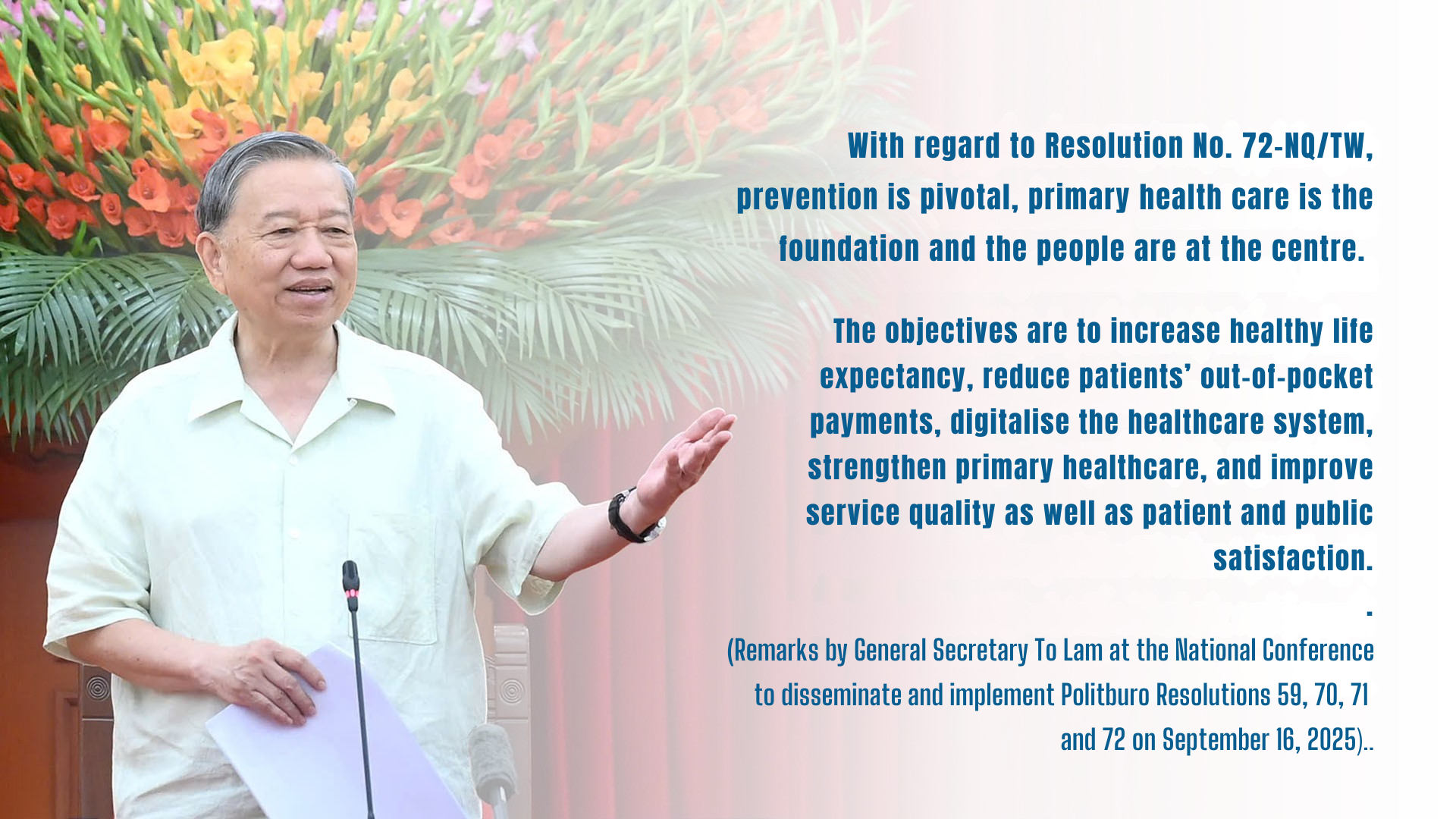
Resolution No. 72-NQ/TW is of particular importance, further reaffirming the Party’s viewpoint that health is the most precious asset of every individual, and the most essential foundation for human happiness, the survival of the nation, and the country’s prosperous and sustainable development. Protecting, caring for and improving the people’s health is both a goal and a driving force, and a top political task, accorded priority in development strategies and policies; it is the responsibility of the entire political system, society as a whole, and every citizen.

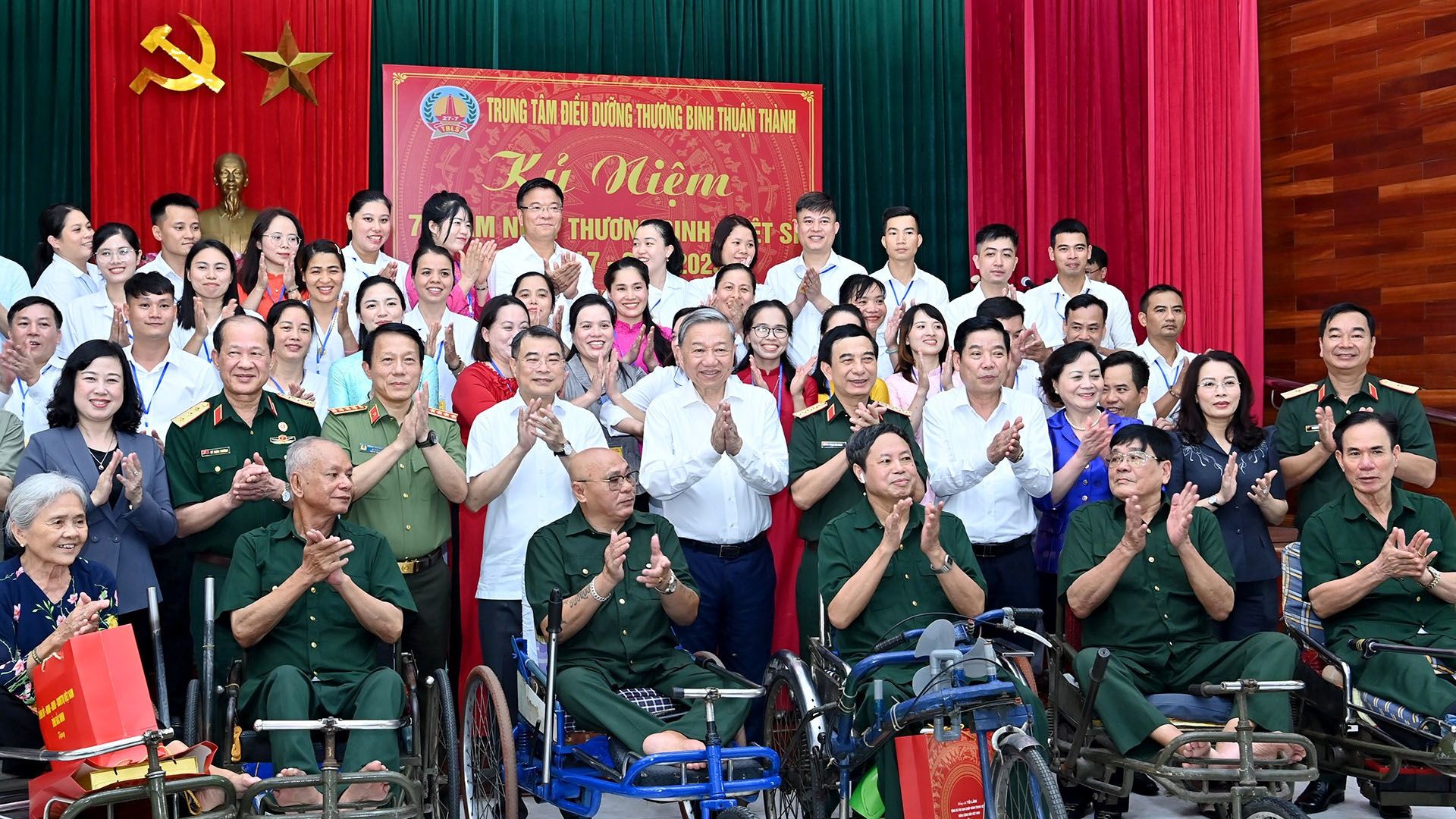
The issuance of Resolution No. 72-NQ/TW marks a profound shift in awareness and action in the work of protecting, caring for and improving the people’s health. At the same time, it introduces comprehensive innovation with breakthrough solutions aimed at building a healthy Viet Nam, where all people receive healthcare, live longer, healthier and more wholesome lives, improve their physical wellbeing, raise awareness of health protection, and proactively prevent disease across society, thereby helping to promote a strong, civilised and prosperous country in the new era.
OBJECTIVES AND VISION
National Health Objectives
By 2030
Increase the average height of children and adolescents aged 1-18 by at least 1.5 cm.
Average life expectancy to reach 75.5 years, of which at least 68 years are lived in good health.
Increase the proportion of people who regularly engage in physical activity by 10%.
Coverage for vaccines under the essential immunisation programme to reach over 95%.
From 2026, people will be entitled to at least one free annual routine health check-up or screening, and will be issued an electronic health record for lifelong health management.
100% of commune-level health stations to be upgraded with facilities, medical equipment, and staffing in line with their functions and mandates; by 2027 each station to have at least 4-5 doctors.
Raising the proportion of medical consultations and treatment covered by health insurance that take place at commune-level health stations to more than 20%.
By 2026, health insurance coverage to exceed 95% of the population.
By 2030, achieving universal health insurance coverage.
By 2030, people to receive basic exemptions from hospital fees within the scope of health insurance entitlements, in accordance with the roadmap.
Developing a wider range of health insurance products.


VISION TO 2045
TASKS AND SOLUTIONS
The Resolution identifies six groups of tasks, breakthrough solutions, and responsibilities in organising implementation.

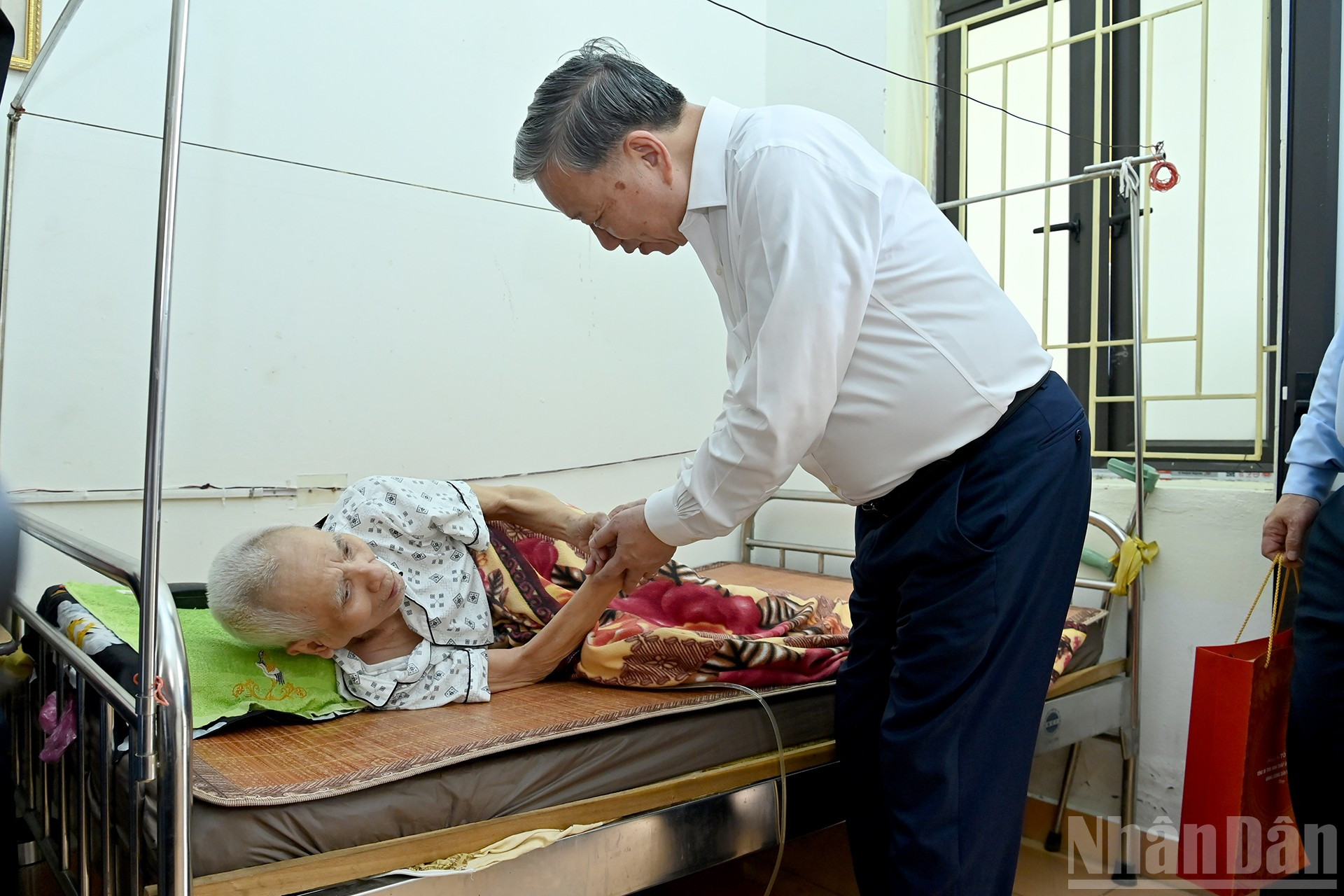
1. Strongly renewing thinking and action in leadership, direction, and organisation of implementation of the work of protecting, caring for, and improving the people’s health:
+ Designating World Health Day (April 7) every year as the “All-People’s Health Day”
+ Minimising the consumption of products harmful to health, especially tobacco, alcohol, beer, and addictive substances that are detrimental to human health.
+ Focusing on mental healthcare, creating balanced living, working and learning environments, and ing stress and pressure.
+ Effectively implementing national target programmes and strategies to improve intellectual capacity, physical strength, stature, and life expectancy of Vietnamese people; the National Nutrition Strategy; and the School Healthcare Programme.
+ Promoting physical education in schools; integrating health and nutrition education into education programmes at appropriate levels.
+ Strongly renewing healthcare governance thinking; creating a transparent governance environment and accountability, linking to administrative procedure reform, thorough hierarchy and decentralisation.
2. Promptly improving institutions, focusing on enhancing the capacity of the healthcare system, especially preventive healthcare and grassroots healthcare, while promoting the strengths of traditional medicine:
+ During the 2025–2030 period, each year localities will rotate or mobilise at least 1,000 doctors to work on a fixed-term basis at commune-level health stations; supplement permanent doctors at commune-level health stations, so that there are enough doctors in line with functions and tasks by 2030.
+ Each province and centrally run city will have at least one specialised hospital; a geriatric hospital or a general hospital with a geriatric department. Develop facilities for elderly care.
3. Enhancing medical ethics; developing a high-quality, standardised healthcare workforce, meeting patient satisfaction and international integration requirements:
+ Increasing the occupational allowance to a minimum of 70% for those who regularly and directly perform medical professional work at commune-level health stations and preventive healthcare facilities.
+ Increasing the occupational allowance to 100% for those who regularly and directly perform medical professional work at commune-level health stations and preventive healthcare facilities in ethnic minority and mountainous areas, areas with difficult or extremely difficult socio-economic conditions, border areas, islands, and for certain special groups.
4. Stepping up reform of health-care financing and developing health insurance policies in an effective and sustainable manner:
+ Implement periodic health check-ups or free screening examinations for the population at least once a year, based on target groups and priority roadmaps.
+ From 2026, organise coordination among periodic health check-ups, free screening examinations, health checks for pupils and students, occupational health examinations, statutory health checks for workers, and health insurance–covered medical examination and treatment, in order to provide free medical examinations and complete the establishment of electronic health records for the entire population.
+ Adopt appropriate support policies for out-of-hospital emergency transportation costs for certain categories of social policy beneficiaries.
+ Gradually implement a policy of exemption from hospital fees, initially targeting social policy beneficiaries, vulnerable groups, low-income earners and certain other priority groups.


5. Creating breakthroughs in the development of science and technology, innovation and comprehensive digital transformation in health care:
+ Urgently build a national health database and a data interconnection and integration system for the health and health insurance sectors.
+ Establish interdisciplinary and specialised research centres in scientific research, combining institutes and universities, and enhance the capacity of research centres, testing facilities, high-technology centres and key laboratories.
+ Form a pharmaceutical industrial park by 2030.
6. Promoting private healthcare development, mobilise and effectively utilise all resources for healthcare advancement:
+ Exemption from corporate income tax for public and private healthcare institutions operating on a non-profit basis.
+ Priority allocation of surplus premises from state agencies, following reorganisation, to healthcare facilities.

Initial results
Implementing Resolution No. 72-NQ/TW

Government
The Government issues Resolution No. 282/NQ-CP on promulgating the Government’s Action Programme to implement Resolution No. 72-NQ/TW.
Ministry of Health
The Ministry of Health issues the Implementation Plan for Resolution No. 72-NQ/TW.
Standing Board of Hai Phong City’s Party Committee
The Standing Board of Hai Phong City’s Party Committee issues Action Programme No. 03-CTr/TU to implement Resolution No. 72-NQ/TW.
Standing Board of Nghi Duong Commune’s Party Committee (Hai Phong City)
The Standing Board of Nghi Duong Commune’s Party Committee (Hai Phong City) issues the Plan to implement Action Programme No. 03-CTr/TU of the Standing Board of Hai Phong City’s Party Committee on realising Resolution No. 72-NQ/TW.









 Built with Shorthand